
Science
RI has a long and successful history in serving customers at large scale research facilities or, put more simply, in “big science”. They build huge machines to push the frontiers of knowledge and technology, and we at RI are thrilled to be a part of it.

Particle accelerators
Particle physics
Cosmology
Energy and fusion research
Particle accelerators
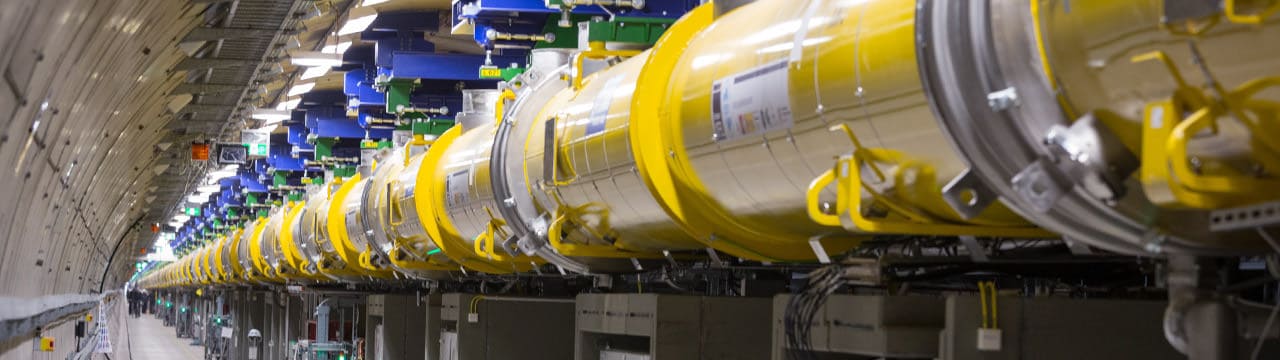
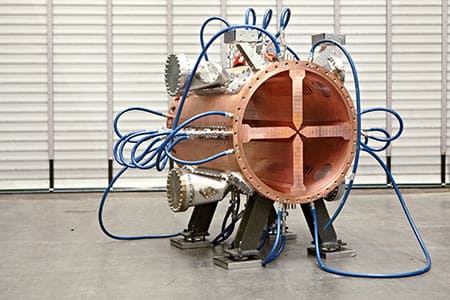
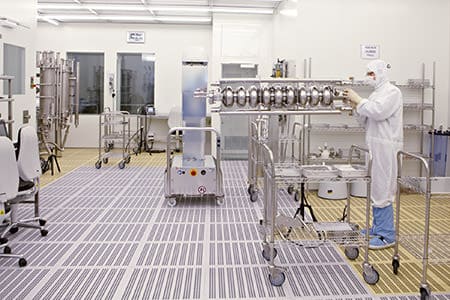
One core expertise of RI is the manufacturing of key components and systems for particle accelerators. Particle accelerators are machines that use electromagnetic fields to propel charged particles like electrons or ions to nearly the speed of light, and to contain them in well-defined beams. They are used for fundamental and applied research in the sciences, but also in many technical and industrial fields unrelated to fundamental research.
Particle physics
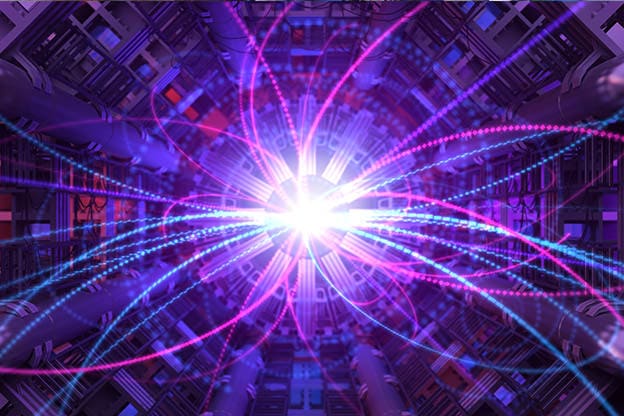
In particle physics, large accelerators like the LHC at CERN in Geneva are used as colliders that open up the window to structures of the subatomic world. Elementary particles are brought to collision at the highest energies possible, and detective work on their fragments after such collisions can hint to the existence of new particles like the famous Higgs boson a few years ago, half a century after it was predicted by theorists.
Cosmology
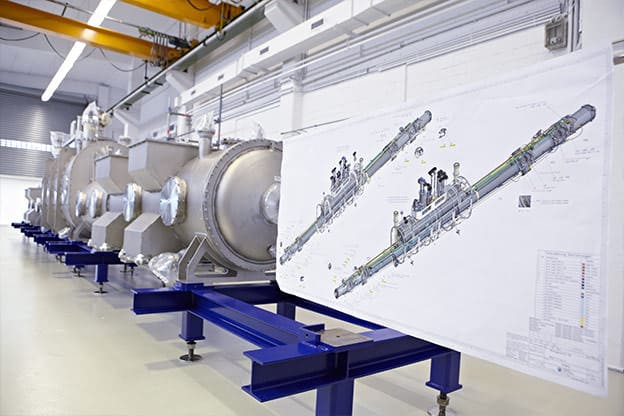
The largest particle source RI has ever built helps to weigh the mass of neutrinos, the most elusive of the elementary particles. The source is part of the Karlsruhe Tritium Neutrino Experiment KATRIN, an experiment of superlatives that aims to complement our knowledge of the universe by answering one of the most fundamental and important questions in modern particle physics and cosmology, namely that of the mass of neutrinos.
Nuclear physics
By colliding heavy atomic nuclei, particle accelerators can also be used to create extreme states of matter in the laboratory that usually only exist in the depth of space. With this, researchers hope to gain new insights into the structure of matter and the evolution of the universe from the quark-gluon plasma right after the Big Bang to the present world as we know it.
Energy and fusion research
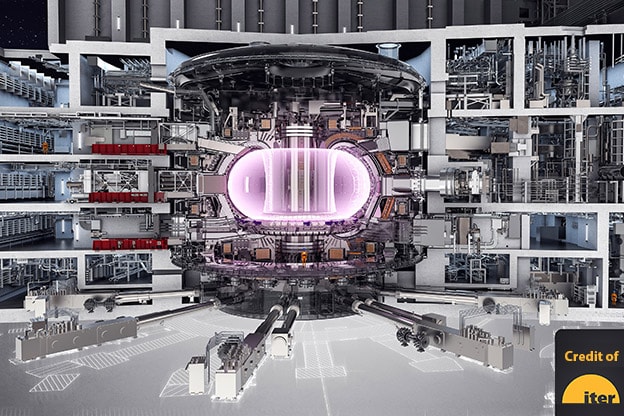
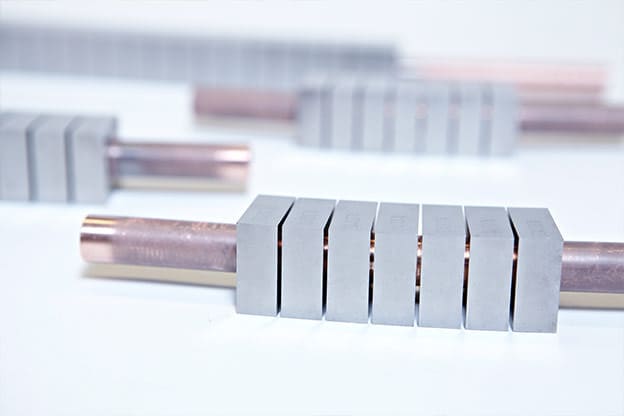
Fusion is a form of power generation relying on nuclear fusion reactions that produce heat. It is the source of energy of our sun, and massive research activities are underway to utilize the same principle for energy generation also on earth. Devices designed to harness fusion heat for electricity generation are known as fusion reactors. Still in an experimental stage now, they are a potential game changer in the world’s energy production. The extreme conditions in fusion reactors pose particular challenges to the materials used and to the supplying industry like us at RI.
Corporate Headquarters
RI Research Instruments GmbH
Friedrich-Ebert-Straße 75
51429 Bergisch Gladbach
Germany
Tel.: +49 2204 – 7062 – 2500
Fax: +49 2204 – 7062 – 2501
Dortmund site
RI Research Instruments GmbH
Hauert 15
44227 Dortmund
Germany
Tel.: +49 2 31 – 4764 – 590
Fax: +49 2 31 – 4764 – 5977
Obereschbach site
RI Research Instruments GmbH
Heinz-Fröling-Straße 3
51429 Bergisch Gladbach
Germany
Tel.: +49 2204 – 7062 – 2500
Fax: +49 2204 – 7062 – 2501